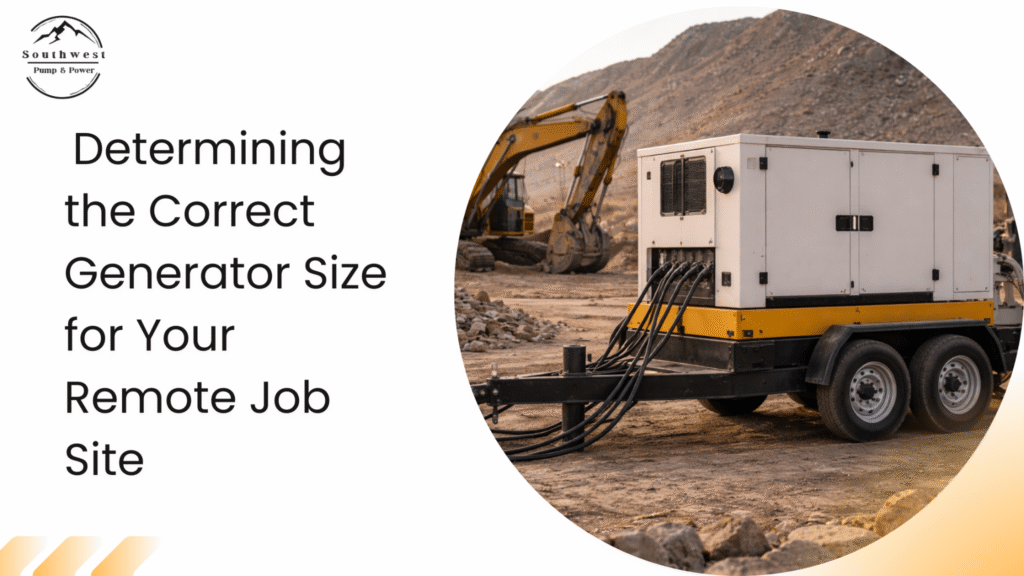
● Generator sizing for remote job sites requires more than adding up equipment loads; it demands understanding startup surges, continuous use, and real working conditions.
● Environmental factors like heat, elevation, space constraints, and fuel logistics directly impact generator performance and must be considered during planning.
● The right generator size improves safety, efficiency, and reliability, helping remote projects stay productive without power-related interruptions.
Remote job sites have a very honest way of exposing weak planning. There’s no grid to lean on, no quick fix when power drops, and no patience from crews when machines stop mid-task. Power is not a background utility out here. It is the engine that keeps work moving, schedules intact, and safety risks under control. What makes generator sizing tricky is that mistakes don’t always show up immediately. A generator might start fine on day one, struggle quietly on day ten, and fail at the worst possible moment. By then, the cost is not just fuel or equipment. It is downtime, rework, and lost trust on-site.
Here is how to determine the correct generator size for your remote job site, step by step, without overthinking or overspending.
- Understand How Your Job Site Actually Uses Power
The first and most important step is getting honest about power demand. Not a theoretical demand. Real, lived, minute-by-minute demand on your site.
a) Running Load Is Only Half the Story
Every piece of equipment has a rated running load, but many machines need far more power when they start. Motors, compressors, welders, and pumps all pull a surge at startup. This surge may last only a few seconds, but if the generator cannot handle it, everything stops.
A generator sized only for running load will struggle the moment multiple machines start together. Proper sizing always includes the highest likely startup demand, not just steady-state numbers. This is one of the most common mistakes made on remote projects.
b) Not Everything Runs at Once
On paper, it’s tempting to add up every tool and assume they all operate simultaneously. On a real job site, that rarely happens. Crews rotate tasks. Equipment cycles on and off. Some machines run continuously, others only occasionally.
The key is understanding which loads overlap in real working conditions. A generator that matches actual simultaneous use will perform better than an oversized unit chosen out of caution alone. This approach also reduces fuel burn and mechanical stress.
c) Continuous Loads Need Breathing Room
Some equipment runs for hours without stopping. Dewatering pumps, ventilation systems, and critical controls fall into this category. These loads should never push a generator close to its maximum rating for extended periods.
Generators perform best and last longest when continuous loads sit comfortably below capacity. That buffer protects against overheating, voltage instability, and premature wear. It is not wasted capacity. It is operational insurance.
d) Power Quality Matters More Than People Think
Undersized generators often produce unstable voltage and frequency. This damages sensitive electronics, shortens tool life, and creates safety risks that are easy to overlook until something fails.
Clean, consistent power is just as important as raw output. Proper sizing supports stable performance and protects everything connected to the system, reducing nuisance shutdowns and the slow, hidden wear that turns minor issues into major repairs.
e) Think Beyond Day One
Remote job sites evolve. More equipment arrives. Work phases overlap. Temporary setups become longer-term than planned. A generator that fits the first week perfectly may struggle halfway through the project.
Good planning accounts for likely changes without overshooting needs. This balance is easier to achieve when power planning happens early, allowing flexibility without scrambling to replace or supplement equipment mid-project.
2. Factor in the Environment and Site Conditions
Even a well-calculated load can fall apart if site conditions are ignored. Remote locations introduce variables that directly affect generator output and reliability.
a) Altitude and Heat Reduce Available Power
Generators are rated under standard conditions. High elevations and extreme heat both reduce engine efficiency. Thin air affects combustion. Hot environments stress cooling systems.
At higher altitudes or during peak summer temperatures, generators can lose a noticeable portion of their rated capacity. If this reduction is not accounted for, a generator that looks adequate on paper may underperform in the field.
b) Fuel Logistics Shape Generator Choice
Fuel availability is often limited on remote sites. Larger generators consume more fuel, especially when lightly loaded. Smaller generators pushed too hard burn fuel inefficiently and require more frequent attention.
Choosing the right size balances output with fuel efficiency and refueling schedules. This balance keeps operations steady instead of being constantly disrupted by fuel runs.
c) Noise and Site Restrictions
Remote does not always mean unrestricted. Some sites have noise limits due to nearby communities, protected land, or project requirements. A generator running near its maximum output is louder and rougher than one operating comfortably within its range.
Proper sizing supports quieter operation and smoother performance, which matters more than many planners expect. It also helps maintain better relationships with surrounding stakeholders and avoids work stoppages caused by noise complaints or compliance issues.
d) Space, Transport, and Placement
Generators must fit the site physically, not just electrically. Oversized units can be difficult to transport, position, and secure, especially when space is shared with other equipment like pump rentals or temporary infrastructure.
The right size fits both the power demand and the physical reality of the site, allowing safer access for crews, easier maintenance, and cleaner site organization as work progresses.
e) Reliability Beats Excess Capacity
A generator that runs reliably every day is more valuable than a larger unit that creates logistical headaches. Remote job sites punish complexity. Simple, well-matched systems win over oversized solutions chosen out of fear.
Reliable sizing reduces emergency interventions, lowers wear on components, and keeps power predictable, which is often the difference between staying on schedule and losing valuable work hours.
3. Choose Capacity with Efficiency, Safety, and Support in Mind
The final piece of generator sizing is thinking beyond kilowatts. The right generator supports the entire operation, not just the electrical load.
a) Load Management Reduces Stress on Equipment
Smart load management can significantly reduce the required generator size. Staggering equipment startups, scheduling heavy loads, and training crews on power use all make a difference.
This approach allows a properly sized generator to perform like a larger one without the downsides of excess fuel consumption and wear.
b) Pumps Change the Equation
Many remote sites rely on pumps for dewatering, transfer, or process control. Pumps often have high startup surges and long run times. They cannot fail without serious consequences.
Generator sizing must account for pump behavior specifically. This is where experience with both power systems and pumping systems becomes critical. Trusted pump and power rental experts understand how these systems interact and plan capacity accordingly.
c) Safety Margins Are Not Optional
Electrical instability creates real hazards. Overloaded generators increase fire risk, damage insulation, and expose crews to unsafe conditions.
A correctly sized generator delivers stable power under all expected conditions, protecting both people and equipment. It also creates consistency in performance, so operators are not forced to work around power limitations or improvise unsafe workarounds under pressure.
d) Match the Generator to the Scale of the Site
Smaller, focused projects may be well served by a 25 kW generator rental for smaller job sites, where loads are predictable and limited. Larger, more complex operations may require a 65 kW generator rental for high-demand remote sites, especially when multiple heavy loads overlap.
The goal is not to hit a number, but to match capacity to the way work actually happens on site. When generator size aligns with workflow, crews move faster and power becomes invisible rather than a daily concern.
e) Experience Saves Time and Money
Every remote job site is different. Soil, weather, elevation, equipment mix, and timelines all influence generator performance. This is why many contractors rely on experienced providers offering generator rentals along with practical guidance, not just equipment drop-off.
Expert input early removes guesswork from planning and replaces it with clarity, helping teams avoid rushed decisions, downtime, and costly mid-project changes.
What Reliable Power Looks Like on a Remote Site
Remote job sites demand systems that work under pressure, adapt to changing conditions, and support people who rely on them every day. Generator sizing sits at the center of that equation. When capacity matches reality, power becomes a strength instead of a stress point. Projects move faster. Equipment lasts longer. Crews stay focused on their work instead of troubleshooting outages. When the generator is sized right, power stops being a risk and starts doing its job.
Southwest Pump & Power builds generator solutions that actually hold up when your job site is miles from the grid. Get in touch to design the right generator setup for your remote project and keep work moving without power becoming the problem